
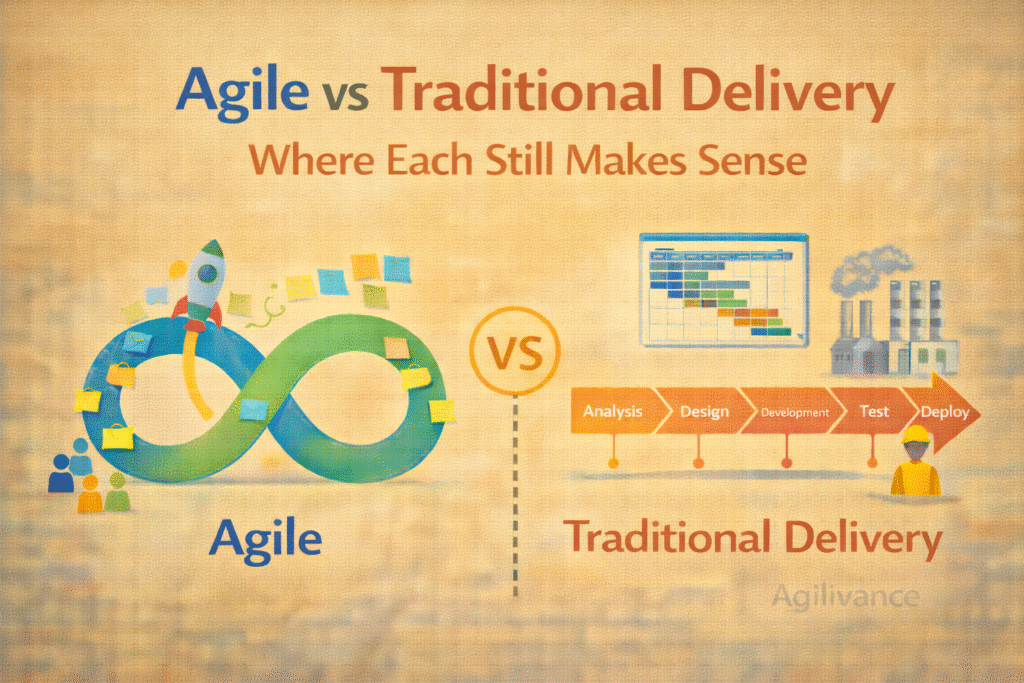
Discussions about Agile often position it as a replacement for traditional delivery models. Waterfall is portrayed as outdated, while Agile is presented as universally superior.
In reality, delivery approaches exist on a spectrum. Both Agile and traditional models have contexts where they work well — and environments where they struggle.
Understanding these differences helps organizations make intentional choices instead of adopting methods based on trends or assumptions.
This article explores where Agile delivery excels, where traditional approaches still make sense, and why many organizations ultimately operate somewhere in between.
What Traditional Delivery Was Designed For
Traditional delivery models evolved in environments where requirements were largely known upfront and change was expensive.
Industries such as construction, manufacturing, and infrastructure rely on detailed planning because altering direction midstream carries high cost. In these contexts, success depends on defining scope early, managing dependencies carefully, and executing against a stable plan.
Key characteristics of traditional delivery include:
- upfront requirements definition
- sequential phases (design, build, test, deploy)
- formal change control
- milestone-based tracking
When work is predictable and outcomes are well understood, this structure provides clarity and control.
Problems arise when traditional models are applied to environments with high uncertainty.
Why Agile Emerged
Agile developed in response to increasing complexity in software and digital products.
Unlike physical construction, software allows rapid change. Customer needs evolve. Market conditions shift. Technical discoveries emerge during development.
Agile was designed to address this uncertainty by emphasizing:
- incremental delivery
- frequent feedback
- adaptive planning
- cross-functional collaboration
Rather than attempting to define everything upfront, Agile teams learn through iteration.
This approach works particularly well when:
- requirements are unclear or evolving
- user feedback is essential
- innovation is expected
- learning is part of the process
Agile treats change as normal rather than exceptional.
Where Agile Clearly Works Better
Agile delivery excels in environments characterized by ambiguity.
Product development, digital platforms, and customer-facing applications benefit from short feedback loops. Teams can release small increments, observe usage, and adjust direction quickly.
Agile also supports experimentation. Features can be tested, refined, or abandoned based on evidence rather than assumptions.
In these settings, attempting to lock down requirements early often leads to rework and missed opportunities.
Agile’s strength lies in its ability to adapt.
Where Traditional Delivery Still Makes Sense
Despite its reputation, traditional delivery remains appropriate in certain scenarios.
Examples include:
- regulatory-driven projects with fixed compliance requirements
- infrastructure implementations with well-defined specifications
- migrations where scope is largely known
- contract-based work with strict acceptance criteria
In these cases, detailed upfront planning reduces risk.
Traditional approaches provide structure when variability is low and predictability is critical.
The challenge arises when organizations apply rigid models to work that inherently requires learning.
The False Binary
Many debates frame Agile and traditional delivery as opposing choices.
In practice, most organizations operate in hybrid environments.
They may use Agile for product development while relying on traditional governance for budgeting and compliance. Teams might work iteratively within projects that still follow annual planning cycles.
This blending is not inherently wrong.
Problems emerge when hybrid models are adopted unconsciously, without clarity about which elements belong where.
Intentional design matters more than ideological purity.
Governance Is Often the Real Constraint
Delivery models are only part of the system.
Even Agile teams operate within broader organizational structures: funding processes, approval mechanisms, performance management, and risk controls.
If these systems remain unchanged, Agile adoption becomes constrained.
Teams may work in sprints, but decisions are still made quarterly. Backlogs exist, but priorities are set externally. Iterations occur, yet releases depend on centralized approvals.
In such environments, Agile practices exist inside traditional governance.
Understanding this dynamic is essential when evaluating delivery effectiveness.
Planning vs Learning
Traditional delivery emphasizes planning.
Agile emphasizes learning.
Neither is inherently superior. The balance depends on how much is known at the start.
When outcomes are predictable, planning adds value.
When uncertainty is high, learning becomes more important.
Organizations often struggle because they apply planning-heavy models to learning-heavy work.
This mismatch creates friction.
Choosing Based on Work Characteristics
Instead of asking “Should we be Agile?”, organizations benefit from asking:
- How clear are our requirements?
- How likely are priorities to change?
- How expensive is rework?
- How important is early feedback?
The answers point toward appropriate delivery approaches.
Some initiatives warrant Agile experimentation. Others require structured execution. Many require elements of both.
The key is alignment with reality.
The Role of Leadership Expectations
Delivery models are shaped by leadership behavior.
If leaders expect fixed commitments, teams gravitate toward traditional planning. If leaders support adaptation, Agile practices thrive.
Methodology alone does not determine outcomes.
Leadership expectations define how work is approached.
What This Means for Organizations
Agile and traditional delivery are not competing ideologies. They are tools for managing different types of work.
Organizations that succeed recognize this nuance. They apply Agile where learning is essential and structure where predictability matters. They design governance to support both.
Rather than forcing all work into a single model, they build flexibility into their delivery systems.
This pragmatic approach enables teams to respond effectively to both certainty and change.
Next Steps: Recommended Reading
Why Agile Fails in Organizations That “Follow the Framework”
Agile Metrics That Help Teams — And Metrics That Quietly Damage Them