
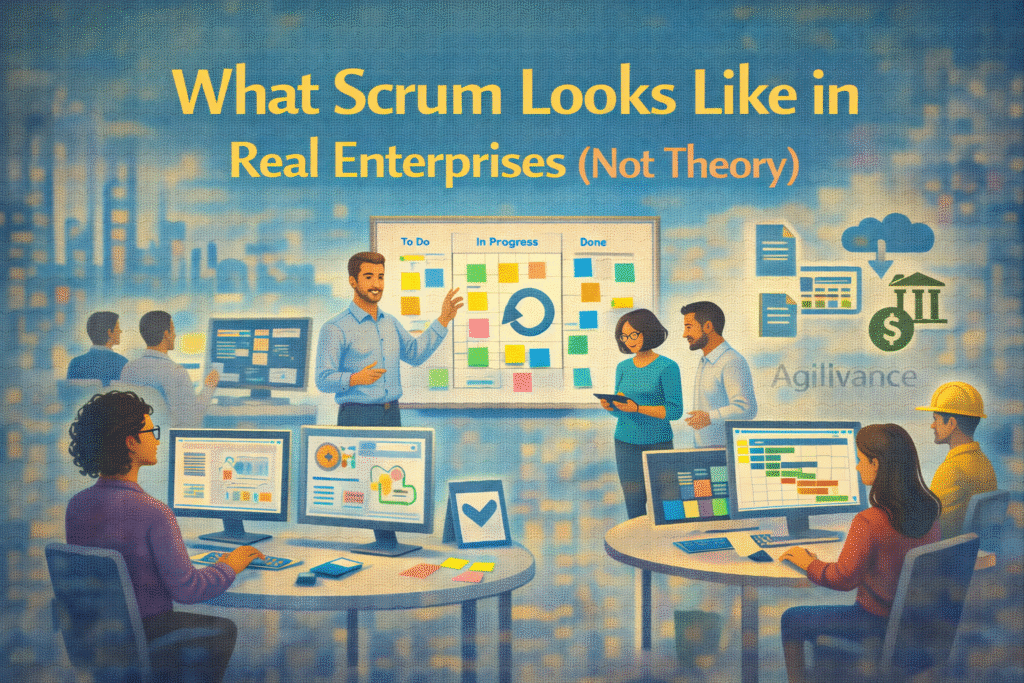
Scrum is often introduced through diagrams, role definitions, and event descriptions. Teams learn about Sprint Planning, Daily Scrums, Reviews, and Retrospectives. Product Owners manage backlogs. Scrum Masters facilitate flow.
On paper, Scrum appears clean and self-contained.
In real enterprises, however, Scrum operates inside complex organizational systems. Legacy processes, governance layers, compliance requirements, and cross-team dependencies shape how Scrum actually functions day to day.
Understanding this gap between theory and practice is essential for anyone working in large organizations.
The Textbook Version vs Enterprise Reality
Scrum frameworks assume relatively small, empowered teams with clear ownership and fast feedback loops.
Enterprise environments rarely offer these conditions.
Instead, teams work within:
- annual budgeting cycles
- centralized decision-making
- multiple stakeholder groups
- shared platforms and services
- regulated delivery pipelines
Scrum does not replace these structures overnight. It adapts to them.
As a result, enterprise Scrum often looks different from what teams expect after formal training.
Sprint Planning in Large Organizations
In theory, Sprint Planning starts with a prioritized backlog and ends with a clear Sprint Goal.
In practice, enterprise Sprint Planning often begins with partially prepared work.
Backlog items may depend on architecture approval, security review, or upstream analysis. Stakeholders introduce late changes. Teams discover hidden dependencies during the meeting itself.
Instead of selecting work based purely on product value, teams balance delivery expectations with organizational constraints.
Sprint Goals become broader. Scope buffers appear. Planning sessions extend longer than intended.
The mechanics remain Scrum-like, but the decision-making context is far more complex.
Product Ownership in Matrix Structures
Scrum assumes a single Product Owner with authority over priorities.
In enterprises, Product Owners frequently operate inside matrix organizations.
They gather input from business units, compliance teams, operations, and leadership groups. True prioritization authority may sit elsewhere.
As a result:
- backlogs reflect negotiated compromises
- sprint priorities shift frequently
- long-term product direction becomes fragmented
Product Owners spend significant time aligning stakeholders rather than shaping product strategy.
This is not a failure of individuals. It is a structural reality of enterprise environments.
The Scrum Master Role Evolves
Scrum Masters are intended to focus on coaching, facilitation, and continuous improvement.
In enterprises, they often take on additional responsibilities:
- coordinating across teams
- managing dependencies
- supporting release planning
- preparing leadership reports
While these activities help delivery move forward, they pull Scrum Masters away from systemic improvement.
The role gradually shifts from coach to coordinator.
Teams benefit operationally, but long-term agility suffers.
Teams Are Rarely Fully Cross-Functional
Scrum describes teams that can deliver increments independently.
Enterprise teams typically rely on external groups for:
- testing
- infrastructure
- security validation
- release approvals
Work flows across organizational boundaries.
Handoffs become part of the process. Delays accumulate. Ownership becomes distributed.
Teams may operate in sprints, but delivery spans multiple organizational layers.
This reality shapes how Scrum is practiced.
Reviews and Retrospectives in Enterprise Contexts
Sprint Reviews often expand beyond product feedback.
They become stakeholder alignment meetings. Progress updates are emphasized. Demonstrations focus on completion rather than learning.
Retrospectives face similar challenges.
Teams may hesitate to raise systemic issues if outcomes are visible beyond the group. Improvement actions become tactical rather than structural.
Psychological safety is harder to maintain when feedback travels upward.
Governance Does Not Disappear
Many organizations assume Agile eliminates governance.
In reality, governance evolves.
Enterprises still require financial oversight, risk management, and compliance controls. Agile teams operate within these frameworks.
The challenge is integrating governance with iterative delivery.
When governance remains rigid, teams experience friction. When it adapts, Scrum gains room to function effectively.
Scrum does not remove governance — it exposes how well governance supports learning.
Dependency Management Becomes Central
In large organizations, dependencies dominate delivery.
Teams share platforms. Release schedules must align. Architecture decisions affect multiple groups.
Scrum events provide limited support for managing these dependencies.
Enterprises introduce additional coordination mechanisms: cross-team planning sessions, integration forums, and portfolio reviews.
These structures coexist with Scrum, shaping how work progresses.
Metrics Look Different at Scale
Enterprise Scrum introduces new measurement needs.
Leadership seeks visibility across teams. Metrics are aggregated. Dashboards emerge.
Velocity and sprint completion rates often become performance indicators.
This creates pressure on teams to optimize for numbers rather than outcomes.
Successful organizations treat metrics as learning signals, not evaluation tools.
What Remains Consistent Across Contexts
Despite these differences, some Scrum principles hold regardless of scale:
- teams benefit from clear goals
- early feedback reduces risk
- transparency improves alignment
- ownership drives engagement
These fundamentals matter more than perfect ceremony execution.
Enterprises that preserve these principles see greater benefit from Scrum adoption.
What This Means for Organizations
Scrum in enterprises is not broken Scrum.
It is Scrum operating inside complex systems.
Organizations that succeed recognize this reality. They adjust structures, clarify ownership, and support teams rather than forcing textbook implementations.
They focus on improving decision flow, reducing dependencies, and strengthening feedback loops.
Frameworks provide guidance. Enterprise outcomes depend on organizational design.
Next steps:
Why Tools Don’t Fix Agile Problems (And Sometimes Make Them Worse)
Agile vs Traditional Delivery: Where Each Still Makes Sense