
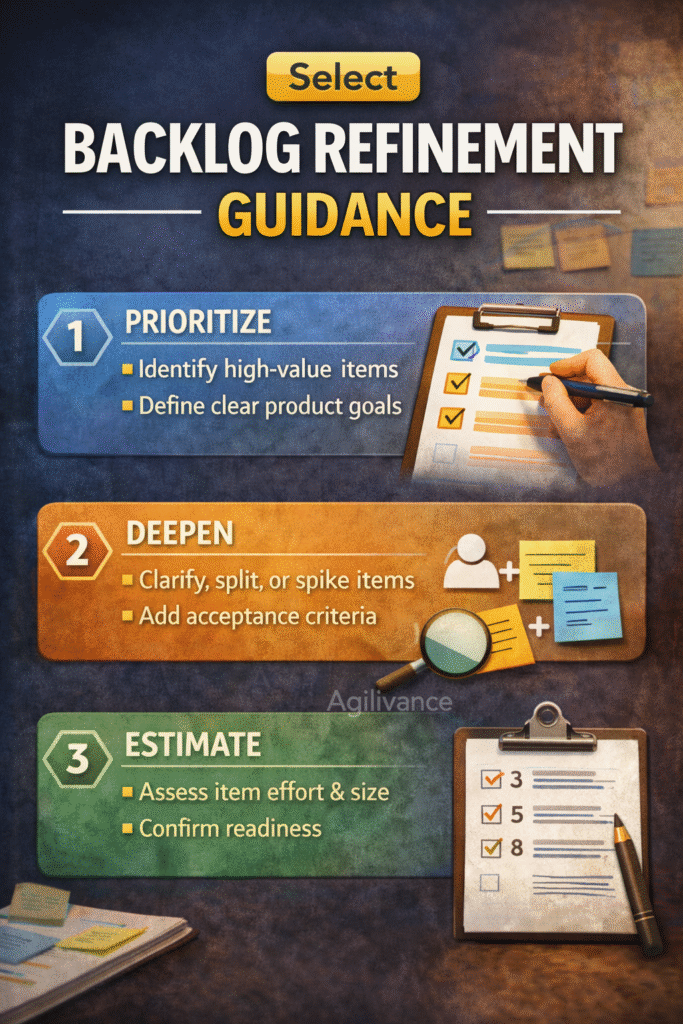
Timebox, Roles, and “Ready Signals” That Prevent Sprint Chaos
Backlog refinement is the quiet work that makes Sprint Planning fast and predictable. When refinement is missing, Sprint Planning turns into a long debate, and teams pull unclear items that fail mid-sprint.
This guide gives you a practical, vendor-neutral checklist and a repeatable timeboxed approach.
Who this is for: Product Owners, Scrum Masters, Developers, QA
Use this when: Sprint Planning runs long, items enter the sprint “half-baked,” or spillover is common
Examples are illustrative and do not represent complete project solutions.
What refinement must achieve
Refinement is successful when your team has a set of items that are:
- Understood
- Small enough
- Testable
- Unblocked or with a clear plan
- Ready enough to start (Definition of Ready)
Refinement is not “final design for everything.” It is “ready enough to start safely.”
Recommended timebox
- 1–2 sessions per week, 30–60 minutes each (start small)
- Focus on the next 1–2 sprints only (avoid over-planning)
If you are a beginner team, do two 45-minute sessions rather than one long session.
Backlog Refinement Checklist
A) Preparation (PO, 10–15 minutes before)
- Top items are ordered (next sprint candidates at the top)
- Each item has a clear description (not only a title)
- Basic acceptance criteria drafted (even minimal)
- Known dependencies are noted
- Open questions are listed (so the team can answer quickly)
B) In-session flow (SM facilitates, team collaborates)
For each item you touch, do this in 3 minutes or less:
- Clarify outcome
- What user/outcome does this deliver?
- Confirm acceptance criteria
- Add at least:
- 1 success case
- 1 validation/error/edge case
- Size & slice
- If too big, slice into smaller testable pieces.
- DoR gate
- If it fails DoR, decide: slice, spike, or defer.
C) “Definition of Ready” signals (minimum gate)
An item is Ready enough only if:
- Goal-aligned
- Understandable in one sentence
- Testable (minimal acceptance criteria exists)
- Sized for the sprint (or explicitly a timeboxed spike)
- Unblocked (or dependency has owner & plan/date)
D) Output of refinement (end of session)
- Top items for next sprint are refined and pass DoR (or have a clear action)
- Open questions have owners
- Dependencies have owners and target dates
- Any spikes are timeboxed with clear learning outputs
- Next refinement session is scheduled/timeboxed
A simple “slice” guide (12 patterns)
If items are too big, slice using one of these patterns:
- By workflow step (create → validate → confirm)
- By user type/permission (basic user → admin)
- By scenario (happy path → edge cases)
- By interface (API first → UI next)
- By complexity (simple rule first → advanced rules later)
- By quality (functional first → performance/security improvements later)
Goal: one slice that still supports the near-term outcome.
Common refinement anti-patterns (and fixes)
Anti-pattern 1: Refinement becomes solution design for everything
Fix: Keep it “ready enough.” Deep design happens as needed during implementation.
Anti-pattern 2: Only PO attends
Fix: Ensure Dev/QA attend so acceptance criteria is testable and realistic.
Anti-pattern 3: No DoR gate, so unclear items enter the sprint
Fix: Apply the DoR minimum gate item-by-item.
Anti-pattern 4: Refinement is irregular
Fix: Put a fixed timebox in the calendar. Consistency matters more than duration.
FAQs
Is refinement a formal Scrum event?
Scrum describes refinement as an ongoing activity, not a formal event with a fixed timebox. The practical best practice is to timebox it so it happens consistently.
How many items should we refine?
Enough for the next sprint plus a small buffer. A common target is 1.5× the next sprint’s forecast so Sprint Planning is not blocked.
Should refinement include estimates?
It can, but don’t force it. The purpose is readiness. Estimates can be done when clarity is sufficient.
Next steps
Recommended reading: