
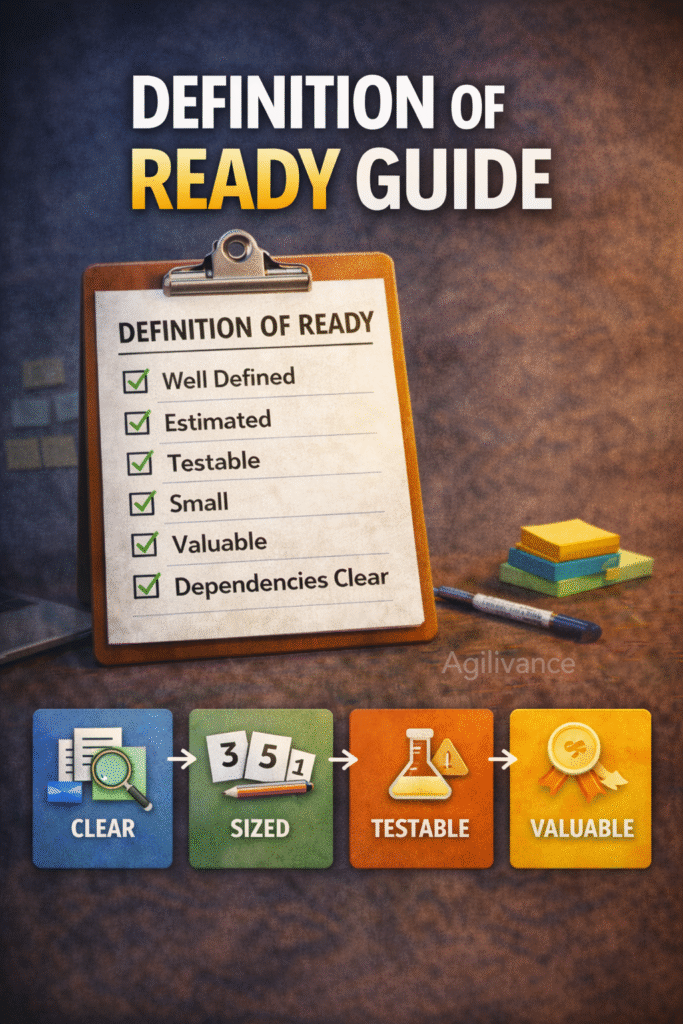
Definition of Ready Guidance
A Practical DoR That Keeps Unclear Work Out of the Sprint
Most sprint problems start before the sprint begins: unclear items enter the sprint backlog, then expand mid-sprint, create blockers, and cause spillover.
A Definition of Ready (DoR) is a lightweight gate that prevents this. It is risk control.
Who this is for: Product Owners, Scrum Masters, Developers, QA
Use this when: items are unclear at sprint start, acceptance criteria is missing, or dependencies appear late
Examples are illustrative and do not represent complete project solutions.
What DoR is ?
Definition of Ready = the minimum standard an item must meet before it is pulled into a sprint.
DoR answers:
“Is this item safe enough to start in a timeboxed sprint?”
DoR does not guarantee no surprises. It reduces avoidable surprises.
Why DoR matters (real impact)
Without DoR:
- Sprint Planning becomes refinement
- Stories are pulled with hidden unknowns
- QA/testing surprises appear late
- “Done” becomes unstable because the scope shifts
With DoR:
- Sprint Planning is faster
- Work is smaller and testable
- Dependencies are visible earlier
- Forecasting becomes more reliable
DoR vs DoD (don’t mix them)
- DoR = readiness to start (inputs)
- DoD = quality gate to finish (outputs)
You need both: DoR protects sprint start, DoD protects sprint completion.
The practical DoR checklist (minimum viable)
Use this as a baseline gate for every delivery item. Keep it short so teams actually use it.
Definition of Ready (DoR) — Minimum Checklist
An item is Ready only when:
1) Clear outcome
- The team can explain what will be delivered in one sentence
- The “why” is visible (what problem/value it supports)
2) Testable acceptance criteria
- Acceptance criteria exists (at least 2–5 bullets)
- Includes at least one edge/validation scenario (not only happy path)
3) Sized for the sprint
- Small enough to complete within the sprint to DoD
- If not small, it is sliced or explicitly defined as a timeboxed spike
4) Dependencies and risks visible
- Key dependency is known (if any)
- If a dependency exists, there is an owner + plan/date
- Major risk/unknown is noted (and handled via spike or slicing)
5) Ready to start work
- The team has what it needs to begin (access, environments, basic info)
- Any required reference links/attachments are present (vendor-neutral)
This is the “minimum viable DoR.” It is intentionally practical.
The quick DoR gate (how to use it in Sprint Planning)
When you are about to pull an item into the sprint, ask:
- Is the outcome clear in one sentence?
- Do we have minimal acceptance criteria?
- Can we complete it to DoD within this sprint?
- Are dependencies known and managed?
If any answer is “no,” do not pull it in as-is. Choose one:
- Slice it (smaller, testable piece)
- Spike it (timebox discovery with learning outputs)
- Defer it (push down backlog until ready)
DoR for spikes (learning criteria)
For exploratory items, DoR should not force “feature AC.” Use learning criteria instead:
Spike DoR (minimum)
- Timeboxed (e.g., 1–2 days)
- Clear learning goals (what we will learn/decide)
- Output defined (options & recommendation & next-step stories)
- Dependencies listed (who to talk to, what access is needed)
Common DoR anti-patterns (and fixes)
Anti-pattern 1: DoR becomes too strict and blocks progress
Fix: use a minimum DoR and allow spikes.
Anti-pattern 2: DoR is used as a blame tool
Fix: treat DoR as risk control, not performance judgement.
Anti-pattern 3: DoR exists, but is ignored in planning
Fix: make it part of Sprint Planning selection. No DoR pass, no pull.
Anti-pattern 4: DoR is different for everyone
Fix: agree a shared minimum DoR, then add team-specific notes if needed.
Quick DoR “ready signals” ready to use
Before pulling an item into the sprint:
- Outcome is clear
- Minimal acceptance criteria exists
- Sized for the sprint
- Dependency/risk is visible and owned
- Team can start without waiting for missing inputs
FAQs
Should every backlog item meet DoR?
Delivery items: yes (minimum). Spikes: use learning criteria.
Does DoR reduce agility?
No. It reduces avoidable waste. You can still adapt during the sprint-DoR just prevents predictable chaos.
Who owns DoR?
The team agrees DoR together. PO often drafts readiness, SM facilitates the process, and Dev/QA validate testability and size.
Next steps (internal links)
Recommended reading: