
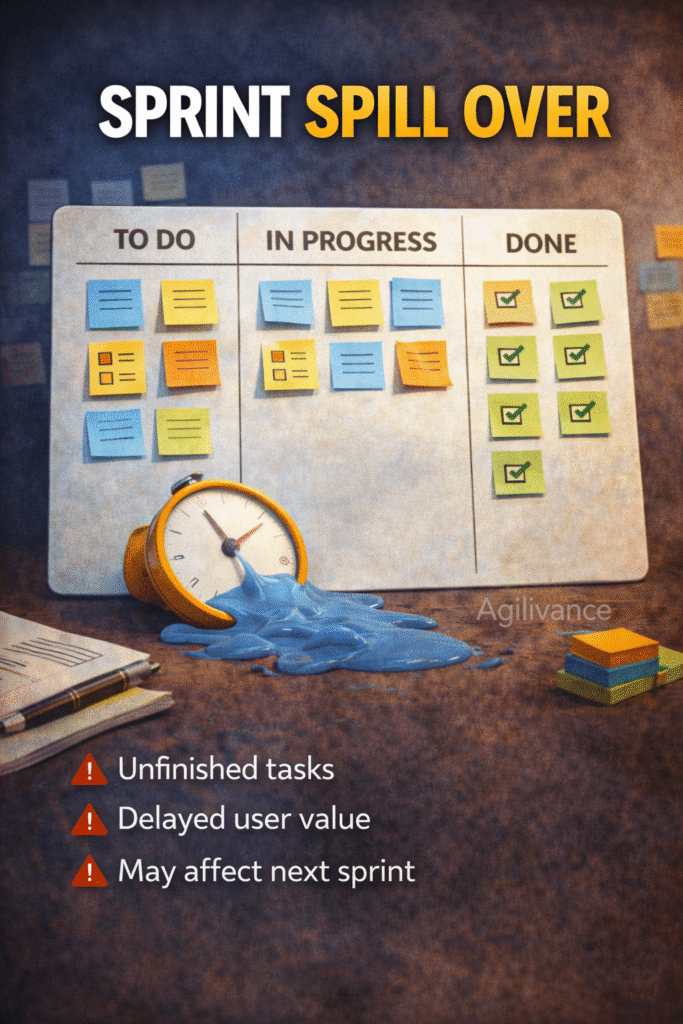
Why Sprints Spill Over
12 Root Causes & Practical Fixes
Sprint spillover is rarely about “lazy teams” or “bad estimates.” It usually comes from a small set of root causes that repeat sprint after sprint.
This guide lists 12 common causes of spillover and gives practical fixes you can apply without adding heavy process.
Who this is for: Scrum Masters, Product Owners, Developers, QA, Delivery Leads
Use this when: work regularly carries over, Sprint Goals aren’t met, or “Done” slips to the next sprint
Examples are illustrative and do not represent complete project solutions.
Simple spillover diagnostic (Begin with this)
Before you change anything, answer these two questions:
- Are we failing because we planned too much?
- Or because work expanded after we started?
Most teams have a mix. The fixes below map to both.
Root cause #1: Sprint Goal is weak or missing
What it looks like: “Complete tickets” goals, constant mid-sprint priority swaps
Fix: write a single outcome-based Sprint Goal and use it to accept/reject new work.
Internal link: Sprint Goal Examples & Quality Test (Post #2)
Root cause #2: Items enter the sprint without DoR
What it looks like: unclear work, missing acceptance criteria, surprise dependencies
Fix: apply a minimum DoR gate (or convert unknowns into timeboxed spikes).
Internal link: DoR Minimum Gate (Post #7)
Root cause #3: DoD is not real (or not followed)
What it looks like: “dev done,” testing/integration pushed to the end
Fix: make DoD visible and enforce it during sprint planning (don’t pull work you can’t finish to DoD).
Internal link: Definition of Done Checklist (Post #6)
Root cause #4: Team plans to 100% capacity (no buffer)
What it looks like: no room for bugs, reviews, support, or interruptions
Fix: plan to ~80–90% and reserve 10–20% buffer.
Internal link: Capacity Planning Guide (Post #3)
Root cause #5: Refinement is inconsistent
What it looks like: Sprint Planning becomes refinement; stories are too big
Fix: timebox refinement weekly and focus on next 1–2 sprints.
Internal link: Backlog Refinement post (Post #5)
Root cause #6: Stories are too big (poor slicing)
What it looks like: items span multiple handoffs, unclear completion path
Fix: slice by scenario, workflow step, user type, or interface (API/UI). Plan one slice, not the entire epic.
Root cause #7: Hidden work is not visible
What it looks like: production support, ad-hoc requests, meetings consume time
Fix: explicitly reserve capacity for BAU/support and make it visible in planning.
Root cause #8: Dependencies are managed late
What it looks like: waiting on another team, environment, approvals
Fix: identify dependencies during refinement and assign owners & target dates. If dependency is unresolved, don’t pull the item as-is.
Root cause #9: Too much WIP (work started, little finished)
What it looks like: many items “in progress,” few reaching Done
Fix: limit WIP and swarm to finish. Finishing work beats starting work.
Root cause #10: Acceptance criteria is weak or missing edge cases
What it looks like: QA discovers “surprises,” repeated rework
Fix: add minimal acceptance criteria (happy path, validation/edge case).
Internal link: Acceptance Criteria Patterns (Post #4)
Root cause #11: Estimation is used as commitment, not forecast
What it looks like: pressure to “hit the number,” risky overcommitment
Fix: treat estimates as planning tools; adjust scope using the Sprint Goal when reality changes.
Root cause #12: Sprint Planning output is not actionable
What it looks like: nobody knows what to start on Day 1; tasks not created; unclear ownership
Fix: end planning with: Sprint Goal, first moves, initial tasks created for the first 1-2 items.
Internal link: Sprint Planning Guide (Post #1)
A simple recovery plan (do this for 2 sprints)
If spillover is chronic, don’t try 12 fixes at once. Use this sequence:
Sprint 1: Protect the sprint start
- DoR gate for items pulled into the sprint
- Smaller slices
- Capacity buffer (10–20%)
Sprint 2: Protect the sprint finish
- Enforce DoD
- Reduce WIP (finish-first)
- Improve acceptance criteria for edge cases
If you do only this, spillover usually improves measurably.
FAQs
Is spillover always bad?
Not always. If priority shifts due to real business changes, some spillover can happen. The issue is repeated spillover from avoidable causes.
Should we carry over unfinished work automatically?
Avoid “auto-carryover” as a default. Re-check priority and re-slice if needed. Carryover should be a conscious decision.
What metric should we watch?
Start simple:
- % of committed/forecast work completed to DoD
- of carried-over items per sprint
Use it for improvement, not punishment.