
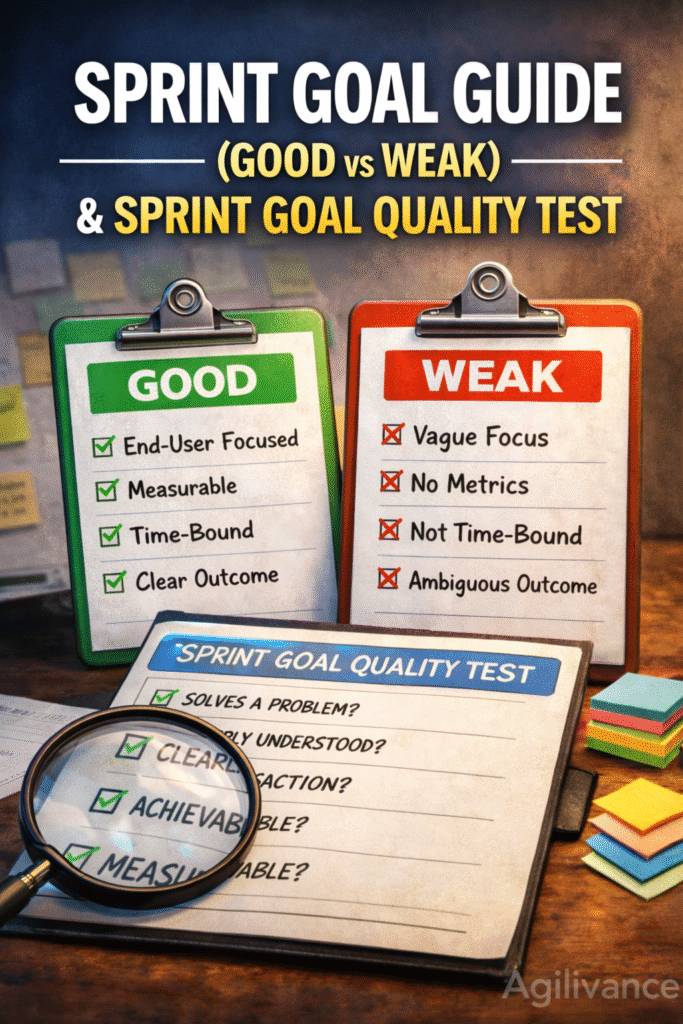
Sprint Goal Guide
Good vs Weak Sprint Goals & A Simple Quality Test
A Sprint Goal is not a slogan. It is the single decision filter that keeps the team aligned when priorities compete.
This guide shows good vs weak Sprint Goal examples and gives you a practical Sprint Goal Quality Test you can use in Sprint Planning.
Who this is for: Scrum Masters, Product Owners, Developers, QA
Use this when: Sprint Goals feel generic, sprints drift mid-way, or work selection becomes random
Examples are illustrative and do not represent complete project solutions.
What a Sprint Goal actually does (in real teams)
A strong Sprint Goal helps you:
- Say no to work that doesn’t support the sprint outcome
- Make trade-offs when unexpected work arrives
- Focus on an outcome, not a list of tickets
If your Sprint Goal cannot guide decisions during the sprint, it is not doing its job.
The Sprint Goal Quality Test (Ready to Use)
Use this in Sprint Planning. Score each criterion 0–2. Total score: 0–10.
Sprint Goal Quality Test (0–10)
1) Outcome-focused (not a to-do list)
- 0 = A list of tasks/features (“finish items A, B, C”)
- 1 = Mixed: partly tasks, partly outcome
- 2 = Clear outcome (“enable users to do X”)
2) Clear and repeatable
- 0 = Vague, unclear wording
- 1 = Understandable but wordy
- 2 = One sentence, easy to repeat
3) Value / user impact is visible
- 0 = No “why”
- 1 = Some “why,” but weak
- 2 = Clear benefit or impact
4) Testable (you can tell if you achieved it)
- 0 = Cannot verify
- 1 = Verifiable but fuzzy
- 2 = Observable / demonstrable outcome
5) Realistic for one sprint
- 0 = Too broad / multi-sprint
- 1 = Risky but possible
- 2 = Achievable with current capacity
Interpretation
- 0–5: Weak goal. Expect drift and spillover. Rewrite it.
- 6–8: Acceptable goal. Improve clarity/testability.
- 9–10: Strong goal. Use it to guide scope decisions.
Good vs Weak Sprint Goal examples
Example 1: Improving a user flow
Weak: “Complete checkout stories”
Better: “Reduce checkout friction so users can complete purchase in fewer steps”
Best (Sprint-ready): “Enable a smoother checkout by removing one major blocker in the purchase flow”
Why “best” works: it is outcome-focused and sprint-sized, without promising a full transformation.
Example 2: Reliability / defects
Weak: “Fix bugs and improve stability”
Better: “Improve stability by addressing the top reliability issues impacting users”
Best: “Reduce the most frequent user-facing error by delivering fixes for the top 2 causes”
This keeps it measurable and sprint-sized without requiring deep technical disclosure.
A simple method to write Sprint Goals (3-step)
Use this template:
“Enable [who] to [do what] by delivering [small sprint-sized outcome].”
Then apply the Quality Test rubric.
Fast rewrite process
- Remove task language (“complete, finish, implement”)
- Replace with outcome language (“enable, reduce, improve, unblock”)
- Ensure sprint-size (“first version”, “top 2 causes”, “one bottleneck”, “one major blocker”)
How Sprint Goals affect scope decisions (what to do mid-sprint)
During the sprint, when someone asks to add work:
Ask one question:
“Does this directly support the Sprint Goal?”
- If yes: negotiate trade-offs (remove or de-scope something else).
- If no: queue it for refinement or next sprint.
This is how a Sprint Goal prevents uncontrolled scope creep.
Common Sprint Goal anti-patterns (and fixes)
Anti-pattern 1: The goal is just the sprint name
Problem: “Sprint 12 – Feature Work”
Fix: Replace with a user outcome or delivery outcome.
Anti-pattern 2: The goal contains 6 separate goals
Problem: “Do X, Y, Z, plus support, plus refactor…”
Fix: Pick one primary outcome; treat the rest as supporting work.
Quick link to DoR / DoD (how they support the goal)
- DoR ensures items pulled into the sprint are “ready enough” to support the goal.
- DoD ensures delivered work actually achieves the goal with quality.
If your Sprint Goal is strong but DoR/DoD are weak, you still get spillover.
Next steps
If you haven’t already, read:
Recommended next posts in this series: